

This weekend at When Words Collide (a fantastic annual Calgary, Alberta conference) I did a panel-style collaborative talk with my good friend Robert J. Sawyer on the topic of An Author’s Guide to Longevity and Adapting to the Changing Publishing Landscape.
I think it was an appropriate topic for both of us, as we’ve been published authors for a combined total of about three quarters of a century. I think Rob’s first published work came the year before my own first rejection which was in 1984.
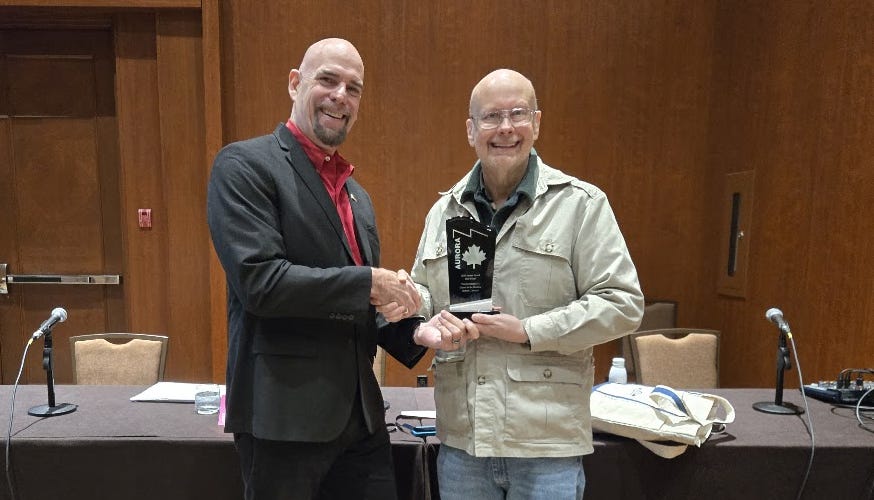
Among the bits of advice we shared with the packed-room of authors included the value of writing things that are personally interesting, that spark your own curiosity, or that you have passion for.
Because, ultimately, publishing is a fickle world, and you’d have a better chance walking into a casino and walking out richer than you went in than finding financial success within the writing and publishing world.
I’ve long shared with authors the importance of writing with passion. You can read more about it in this article…
I Knew I Knew You! You're the Writer Who Tried to Write with Passion!

I’ve long said that one of the most important and powerful things a writer can do is when they attack a writing project with passion.
. . . but, in a nutshell, the satisfaction of investing your blood, sweat and tears into a project you are personally excited about working on is one of the only guarantees you’ll get in that writer journey. Because most books don’t sell that well. So it means you win just creating the book. And if it happens to sell, you win AGAIN.
But it also leads to something another good friend of mine, James A. Owen often tells other writers. “I believe in you, and I won’t let you fall.”
Sometimes, when toiling in the fields, a writer loses that faith, struggles with that passion, and begins to doubt themselves, and stops believing in themself. That hurts me to see. And it’s one of the reasons why I do my best to go out of my way to lift up other writers wherever and however I can. (And I don’t mean blowing smoke up their ass—but instead, appreciating their passion and enthusiasm, and finding ways to help them)
As James A. Owen also says: If you really want to do something no one can stop you. But if you really don’t want to do something no one can help you. James also speaks about how when you’re enthusiastic about something, and determined, people will often find ways to help you.
For example, when I was first self-publishing back in 2004, I remember how my friend and mentor Robert J. Sawyer cautioned me about what I was getting into. (Back then it was even before the “wild west” of self-publishing, and a major way for a writer to lose respect. But, even though Rob cautioned me about what I was getting into, he never stopped supporting and helping me, even offering me a blurb for that first self-published horror story collection). He saw my passion, and helped prop me up.
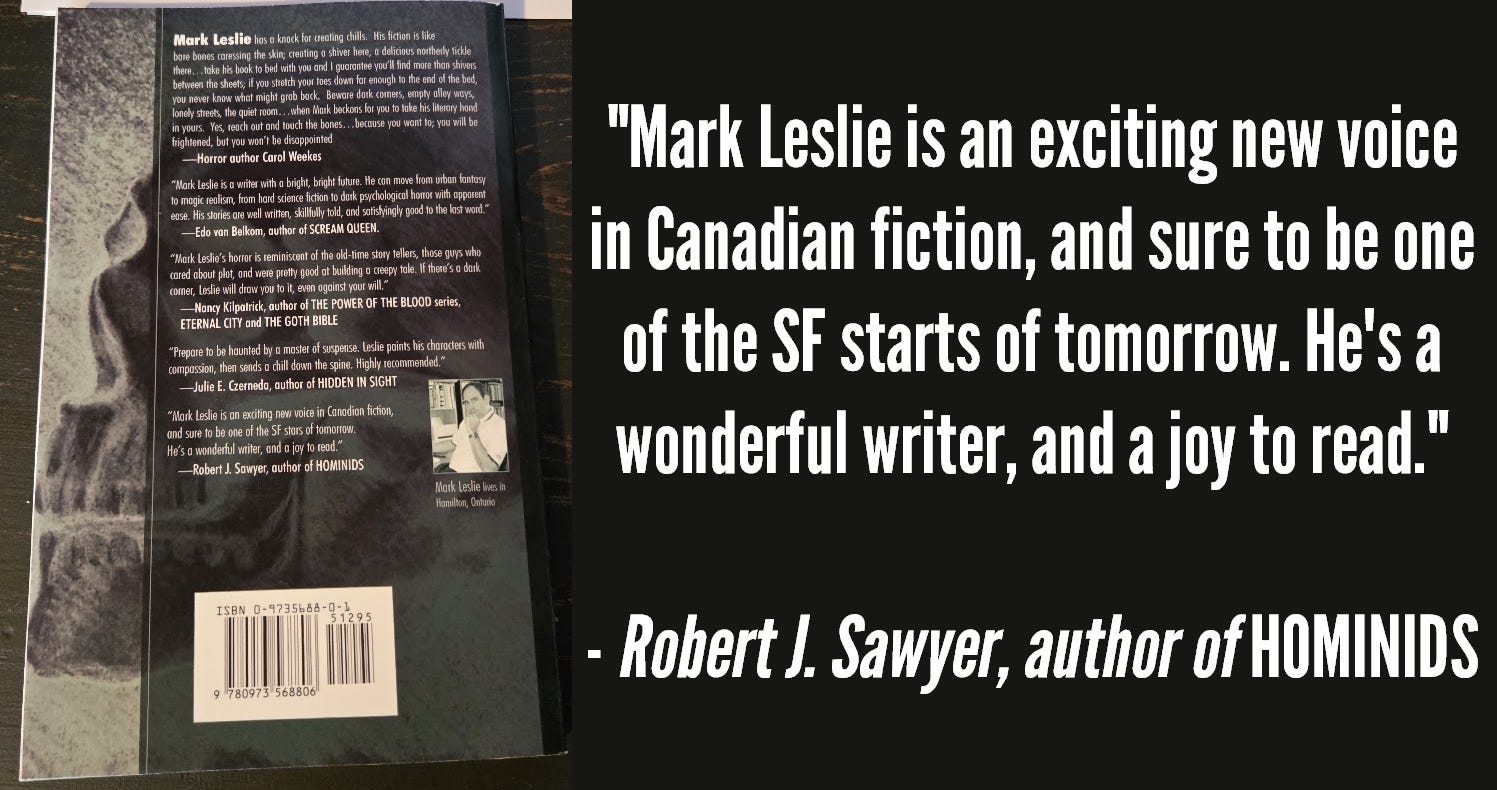

I’ve also tried to help other writers. And I’m really following the example of awesome folks like Rob and James, and so many other writers who take the time to offer a bit of support, encouragement, and belief in other creators. I mean, really, what does it cost us to pay it forward in whatever little ways we can?
Because sometimes, that little bit of faith, encouragement, or belief might be the thing that the other author needs. That small grace might get them through a challenging moment of self-doubt. And help remind them of the value of believing in themselves.
Also, this morning, when I went to open Microsoft Word, I found the remnants of something I’d drafted about authors who believed in themselves, who experimented, who didn’t take the book industry’s “No!” for an answer and charted their own unique pathway through publishing.
It was a bit of the backstory of another writer friend: Terry Fallis.
And as I was reading through my notes and thoughts about Terry’s unique and unorthodox journey into publishing (a fantastic example of someone who wrote with passion and didn’t let the traditional publishing road blocks get in his way) I realized I did play at least some small part in that journey. (And no, before I go on, I’m not going to break my own arm patting myself on the back. But Terry has shared with me the small but perhaps important role I played in that journey because, as a bookseller, I believed in him)
But, speaking of Terry’s journey, I’ll try to compose a bit of a brief look at it.
(Though, admittedly, my version isn’t only extremely short, it’s nowhere near as entertainingly written as Ter’s version. Go check out Terry’s own multi-part storyline about it. Here are the links. Part 1: In the Beginning. Part 2: What pushed me over the edge to start writing? Part 3: But how do I write a novel? Part 4: Striking out with the publishing establishment f. Part 5: A Book Making Its Way. Part 6: My Leacock shock. Part 7: Post Leacock: A whole new world. Part 8: Canada Reads 2011. Part 9: What? A TV miniseries? Part 10: And a stage musical, too?)
Terry, a lifelong creative person from a creative family, had written a satirical novel about Canadian politics called The Best Laid Plans. Agents weren’t interested. Editors weren’t interested. Publishers weren’t interested. How could anyone be interested?
Honestly, I’m not sure if the topic area could be any higher on the scale of “boring” and “not interesting.” I know that I, for one, felt exactly that way when I first heard about it.
But I’m getting ahead of myself.
Needless to say, Terry met roadblocks when it came to traditional publishing. But, as mentioned, he’d been a singer and writer his entire life. He wasn’t going to let something as minor as “nobody was interested in this book” stop him.
He was, after all, quite fond of his particular “fish out of water” storyline of Angus McLintock. It had moments of humor and tenderness. The narrator was also someone who worked in Canadian politics. (Terry had worked in the past as a script writer for the Canadian government and was familiar with that world)

With a background (and a day-job) in marketing, Terry leveraged his creative and advertising-world skills to record an audio version of the book which he released chapter-by-chapter in podcast format.
He followed that with a print-on-demand version of the book (paying one of the world’s largest vanity press outfits. Before you judge him, this was the VERY early days of self-publishing. He was doing this in 2005, pretty close to my own first self-published book in 2004).
This was also the earlier days of podcasting. A few other writers (like Scott Sigler) had leveraged podcasting in a similar way. And Terry’s podcast caught on. He had listeners from around the world.
I was one of them.
Reluctantly, at first.
At the time I was the Book Operations Manager for Titles, the bookstore at McMaster University. I’d rec’d an email message from Terry letting me know he was a graduate of the university (Engineering) and that he’d self-published a book and was curious to know if I’d be willing to carry the book.
Though I’d long been an advocate for local authors, I’d already had almost fifteen years of experience as a bookseller seeing enough hastily compiled and unedited self-published books with ugly covers to instantly roll my eyes.
But he was a graduate of the university. I figured I’d owe him at least a look at what he book was about. Oh no, another cringe. Because I could hardly imagine a more boring topic that was the furthest from anything I was interested in.
So I moved on with my day.
But Terry was persistent. A few days later I came back to my office to a voice mail message from him.
I sighed. Then went off to search for his website.
And that’s when I saw he had a podcast of the book. I had been a podcast listener for several years already and back in those days there weren’t nearly as many available. So I figured I’d check out his book by downloading the first episode, side-loading it to my little mp3 player, and listening on my walk from central campus to the furthest parking lot. It was about a fifteen minute walk.
I figured that would be enough.
It was a well-produced audio, and Terry’s voice was pleasant to listen to. But then the story hooked me almost immediately.
I was captivated by the humor, the tone, the characters. It had elements from two beloved writers. It reminded me of John Irving (A Prayer for Owen Meany is one of my all-time favorite novels. I only later learned that it was also a fave of Terry’s) and some of the humor from Robertson Davis in his ghost story collection High Spirits. (I think at some point Terry also shared with me that Robertson Davis was another of his favorite writers).
The first thing I did when I got home was download the rest of the available episodes.
And the following day I called Terry back to tell him I’d loved what I’d read of the novel so far and would be honored to have him come to our bookstore and do a launch for it. And then I binged the rest of the book.
I then I went on to Ingram (the POD book was available to bookstores as a non-returnable title), and ordered 45 copies. I didn’t care that they were not returnable. I loved the book, and knew that if they didn’t sell at the launch, I’d hand-sell them to people.
A few weeks later, Terry came out to McMaster and several faculty members and other folks who worked at the university came out to support him. The Daily News and student newspaper covered the story.
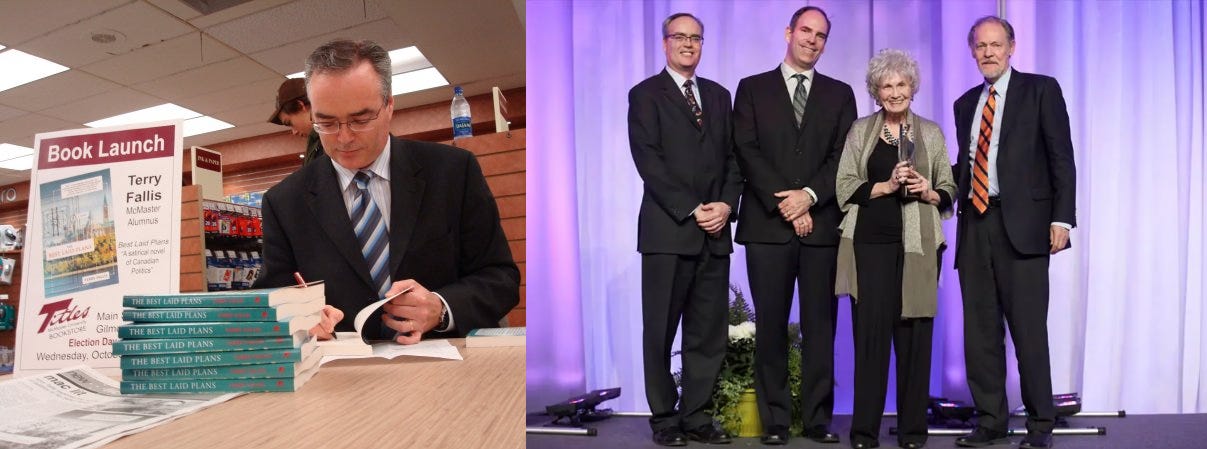
Terry was such a delightful author to have at the store. He was entertaining, pleasant, funny, and kind. He won me and the staff over so heartily. On that launch day we sold almost every single title brought in that day. I immediately went and ordered more stock for the story so that we could always have the book in stock. It was, after all, a recent favorite of mine, and I knew I’d be putting it into the right readers’ hands if they were looking for a fantastic humorous yet touching novel.
Little did I know that the enthusiasm I’d shown to Terry and his novel had a positive impact on him in the fact of the giant uphill battle of the self-published author.
Terry had enjoyed his experience at the store, and when he got home, he felt inspired enough to submit his book for consideration for that year’s Stephen Leacock Medal for Humor. Two things worked in his favor. He had exactly five author copies of the book on hand. And they didn’t have any rules about self-published books not being allowed.
Long story short: The Best Laid Plans went on to win the 2008 Stephen Leacock Memorial Medal for Humour. It is Canada’s most prestigious award for comedic writing. He even beat out Canadian heavyweight names like Douglas Coupland and Will Ferguson.
So this same novel that no publisher was interested in had suddenly won a major national award.
An agent and publisher connected with Terry. (Interestingly, he never mentioned this book to friend Douglas Gibson, the head of McClelland & Stewart and the Douglas Gibson imprint, then operated by Random House Canada). In 2011 the book went on to win CBC’s Canada Reads, crowning it “the essential Canadian novel of the decade.” The book was adapted into both a stage play and a CBC television mini-series.
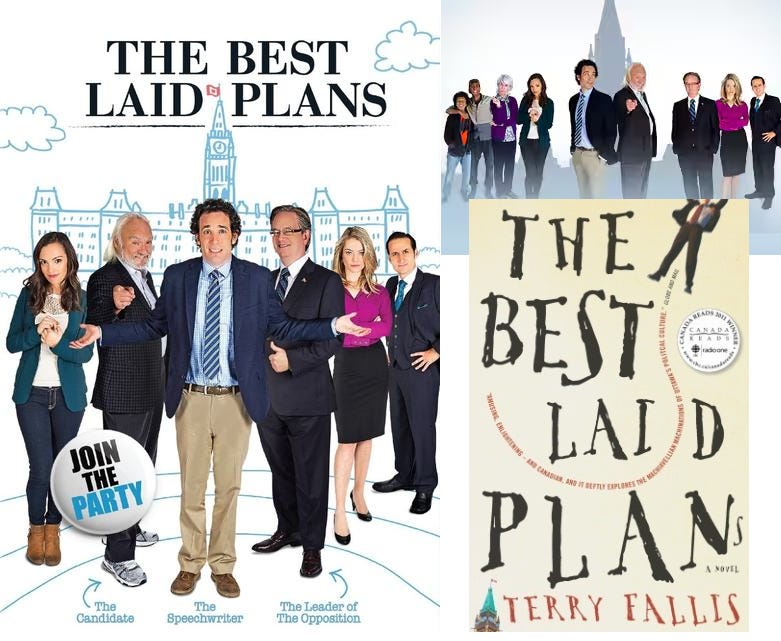
Terry has gone on to win more awards, and publish ten novels, with his eleventh scheduled for November 2026. He is one of a handful of writers whose books I buy on sight. And I’ve loved every single one of them. And I know he and his books are a gift to both Canada and to the world.
But none of this would have happened if Terry didn’t believe in himself, and believe in a novel that was based on the things he knew (speech writing for the Govt, engineering, teaching, marketing) and to persist through the hurdles thrown in his face.
Perhaps my own enthusiasm for Terry and that first novel—my own belief in him—played a small role in helping pad his confidence at a time when he needed it. He was on a bit of a book-launch high, after all, when he submitted the book to a contest in which became a bit of a life-changing contest win.
And that, to me, is the reminder, as both a bookseller/book industry professional and as a fellow writer, to always take the time to pay attention to, to listen to, and to cheer on other writers. Whenever and wherever I can. Including the conference I’ve just returned home from.
Sometimes, all it might take is a bit of genuine interest, a bit of a kind word, a thought, a willingness to sit in the moment and to listen to someone when they are talking passionately about their art. Then they make the art. And that art makes the world better. You never know what sort of different that little bit of something that costs you so little can make.
I’ve learned such things from friends and mentors like Rob Sawyer, James Owen, and so many others. It doesn’t really cost that much to spend a few moments listening to someone, and saying to them through your actions, without stating the actual words “I won’t let you fall” or “I believe in you” or “I believe in what you’re doing.”
Because sometimes that might be all that it takes to help fill the bucket of another creator. No major gestures needed. Just a kind ear or eye. Just a pittance of time. But it could make a world of difference.
And it might be the fuel that can help that creator rekindle the passion and the belief in the project that they were drawn to with passion. It might spark more of the much-needed persistence required to get beyond the many more hurdles that are likely to come their way.
If you’re curious about Terry, you’d be doing yourself a huge favor to check out his novels. And you can also read his own articles, thoughts, reflections, and musings here on his Substack at A Novel Journey.
This is so true. I've been fortunate to find some authors in my genre who love and support my work. It's definitely a two-way street, since I do the same for them. I firmly believe that a "rising tide lifts all ships."
Thanks for all you do to encourage your fellow authors!