
Hat Switch on the Highway: A Tale of Two Markies
Rambling Reflections on the Road and Reclaiming my Horror Identity to StokerCon

BTW, before we begin, it’s important to me that you read the first part of the title of this article to the tune of the opening line from Steppenwolf’s “Born to be Wild.” You got the little ear-worm? Good. And I’m sure you recognize the Charles Dickens nod in the second part of the title. You see, even my titles are trying to do two different things simultaneously, just like the way I’ve been living most of my adult life. Now we can continue.
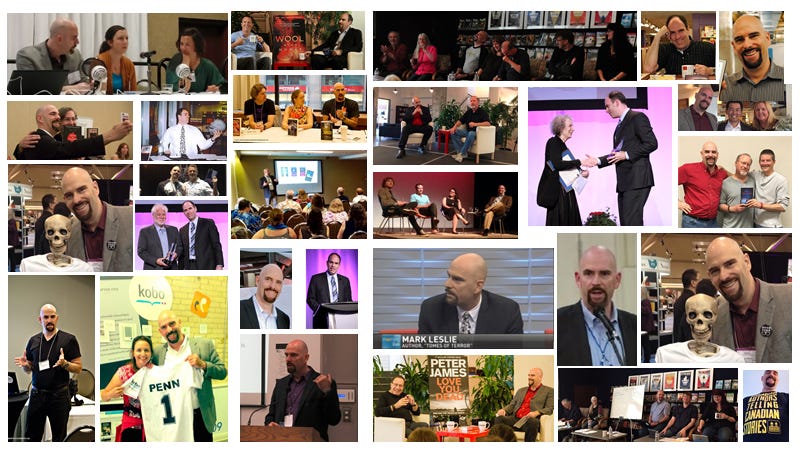
This is the tale of two Marks. Two personas who have both co-existed and struggled for dominance. Who have supported and propped one another up, but also stepped on the other in their desperate climb for the top.
And it’s a struggle I’ve long known about, but haven’t spent much time reflecting on. Well, at least not publicly.
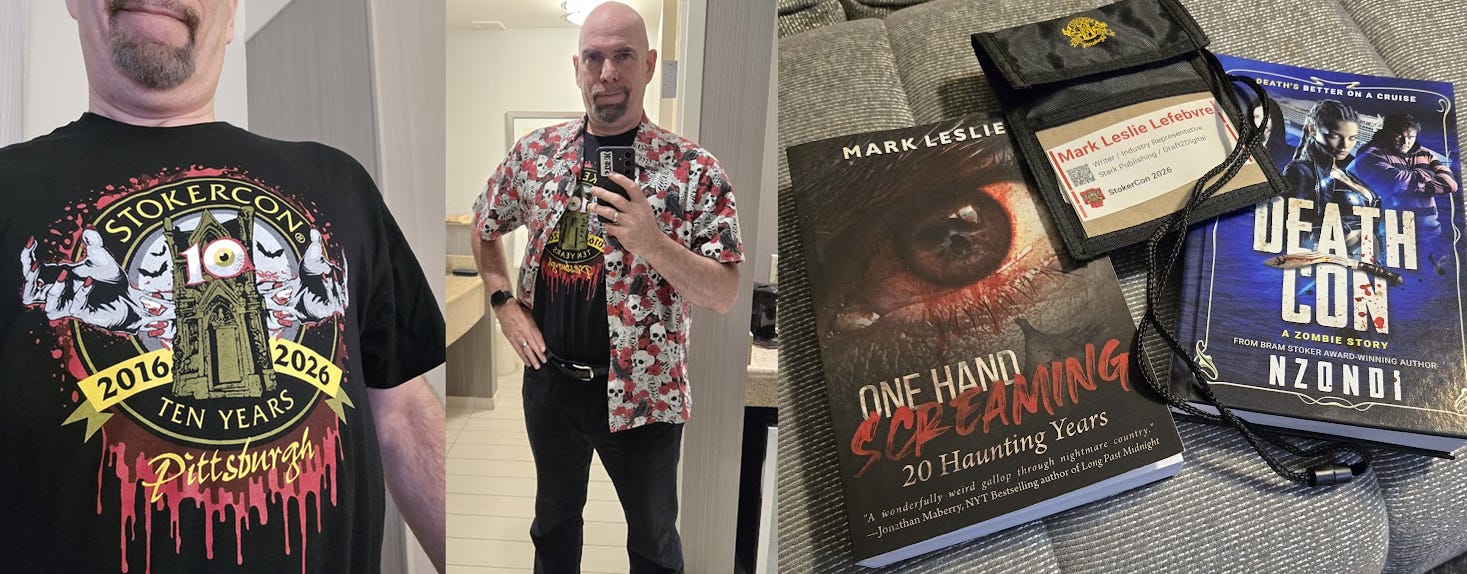
I just got back from StokerCon, an annual professional literary and community-focused conference all about horror, involving writers, editors, artists, publishers, agents, and other industry professionals put on by the Horror Writers Association (HWA).
The last horror writing conference I’d been to as an author was at World Horror Convention in Toronto in 2007. And I’d never been to StokerCon. It is relatively new, celebrating it’s tenth anniversary this year. It took the place of the previous World Horror Con that ran for 26 years and ended in 2016.
But I digress. Just like I do, I suppose, consistently in my writing persona and the back-and-forth switch of writer and book industry guy.
In the early 1980s, when I knew I wanted to be a writer, I adopted the pseudonym, and the persona of Mark Leslie. I did it mostly because I figured that nobody would ever be able to spell or pronounce Lefebvre. And it was also my actual first and middle name. So it was still me. Just an easier-to-remember-how-to-spell-and/or-pronounce kind of name.
I’d learned that strategy from the author notes section from a Piers Anthony novel. (He was born Piers Anthony Dillingham Jacob). But c’mon, it’s easy for most people to pronounce any and all of those names. He didn’t have a smorgasbord of silent consonants to contend with jumbled back to back in his name.
But I digress again. Story of my dual life.
I love Mark the book industry guy. He goes about the world under the name Mark Lefebvre and Mark Leslie Lefebvre. I think he’s a pretty cool dude. And he’s sometimes even well-known within specific author and book industry communities.
He is a former President of the Canadian Booksellers Association, former Director of Self Publishing and Author Relations for Rakuten Kobo (that “Mark from Kobo” guy created and launched Kobo Writing Life), he is one of the founders of the Wide for the Win company and an early advocate in that movement (he did write a book by that name, after all), he is the guy behind the Stark Reflections on Writing and Publishing Podcast which is in its 9th year of never missing a single weekly episode, and he regularly represents Draft2Digital in talks, conferences, and business meetings.
Along the ride with Mark The Book Industry Guy, or Mark Leslie Lefebvre, I’ve experienced some truly amazing things. And I know he has helped thousands of other writers.
He’s someone I admire, and yet continue to try to be like. His persona is helpful yet honest. Stark, yet empathetic. Loud, yet quietly supportive.
I don’t think I could ever truly give him up. I love helping other writers so much. It’s truly something I get a valuable intrinsic reward from. And there’s no mistaking the fact that so many fantastic opportunities and experiences I’ve had over the years came from the decades of learning and investment into Mark Lefebvre or Mark Leslie Lefebvre.
But too often, since 1992 I suppose, when he started working part-time as a bookseller, he has taken the wheel. He has overshadowed Mark the writer, Mark the horror guy. Or Mark Leslie.
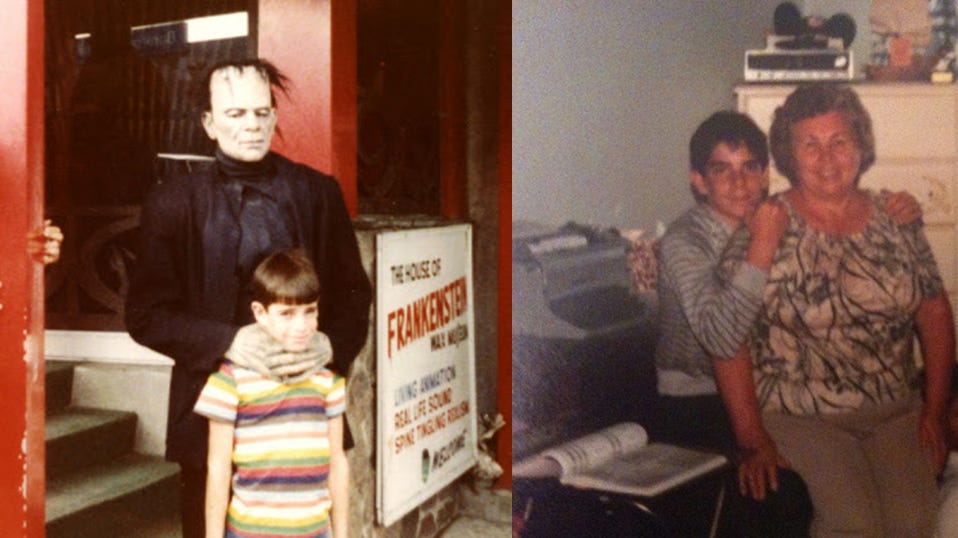
Who is Mark Leslie? He’s that kid who knew he wanted to be a writer. He’s also the guy who, like some werewolf, usually only shows his true hairy face after dark, in the shadows, or, much like that lycanthropic creature, during the days of a full moon.
In other words, he has regularly taken the back seat while the louder, the prouder, the more dominant Mark Leslie Lefebvre takes the wheel.
I’ve struggled with these two personas, doing my best to make the most of each of them, and to toggle between embracing them both.
But they are two interestingly and distinctive parts of this coin I keep tossing.
More often than not, since perhaps the late aughts, though, the coin had landed more with the Mark Leslie Lefebvre side facing up. Even when I’d finally started to make enough money from my writing that in 2017 I left full-time employment, believing this would be the time for Mark Leslie to stand proudly without the need to lean so much on Mark Leslie Lefebvre, I found myself unable to stop myself from slipping back into those comfortable shoes.
On my recent drive to StokerCon I decided I’d reflect on that, as I do from time to time, for my weekly podcast.
I was looking to reclaim a bit more of that Mark Leslie guy and started reflecting on that while driving between Waterloo, Ontario, and Pittsburgh, Pennsylvania.
Before I left, my partner had asked me, gently and reasonably, what the trip was going to cost. It was a fair question. It is always a fair question. And yet some stubborn part of me heard it the way a teenager hears a parent ask whether this band thing is really going anywhere.
That, right there, is the knot I have never quite managed to untie when it comes to that Mark Leslie guy.
As I mentioned, to a good chunk of the publishing world, I am the industry guy, Mark Leslie Lefebvre, helping authors find their readers in all the places beyond the single retailer most of them default to. I get invited to speak. I sit on panels. I have interviewed authors like Michael Connelly, Peter James. I have handed lifetime achievement awards to Margaret Atwood and Alice Munro. From the outside, I imagine it all looks reasonably shiny.
But the industry guy is not who I set out to be. He is who I became on the way to something else.
I got into this business in the first place because I wanted to write—horror, ghost stories, the things that go bump in the night. The bookstore job, the inventory spreadsheets, the platforms and the panels: all of it grew, in one way or another, out of a kid who loved scary stories and wanted to spend his life near books.
My mom gave me some solid advice when she heard me repeatedly say that I wanted to be a writer. She made it clear to me that writers never earned enough money to live on, so if I wanted to be a writer I’d better have a good job.
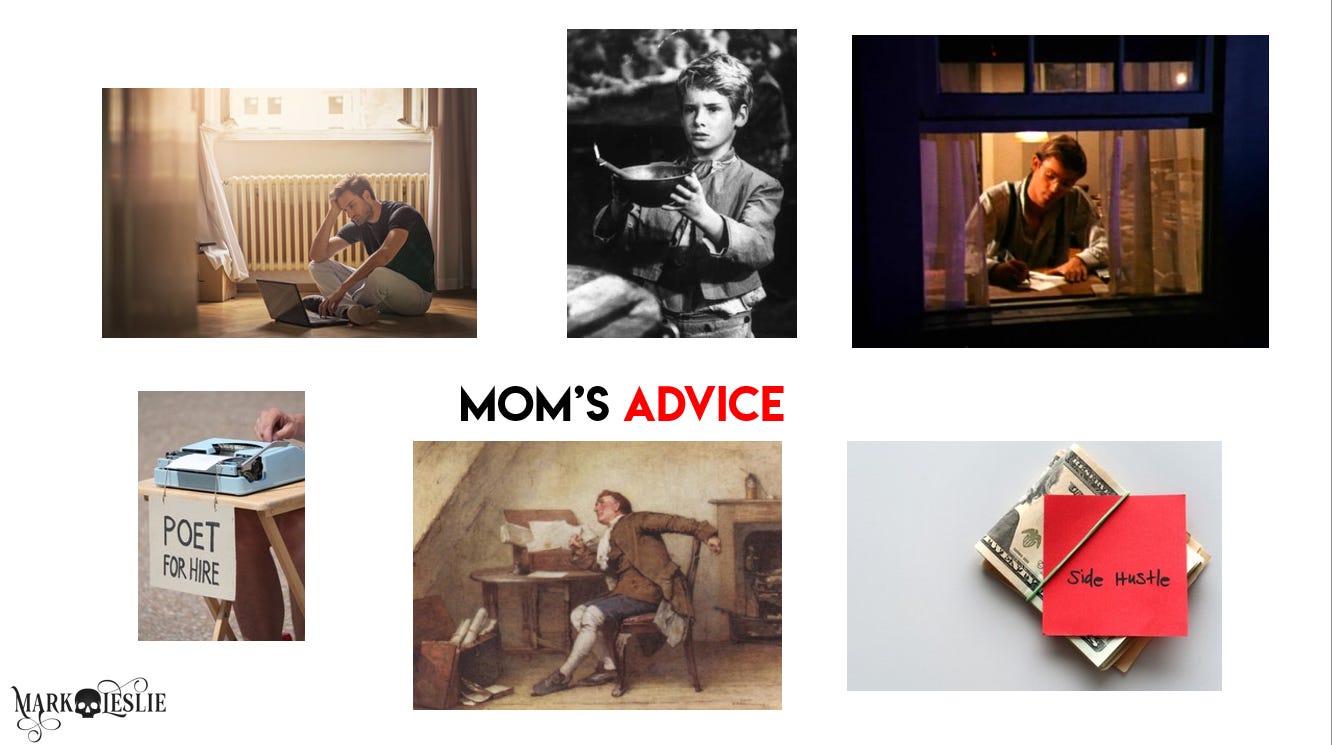
She wasn’t being mean. She was being pragmatic. And she was wiser than I ever gave her credit for.
But I did follow that advice. Though I did it like I do most things. I adapted solid advice from a wise person into something I could make fit and work with what I cared about the most. I followed her advice in a way that was always adjacent to my biggest passion.
I came out of university with an English degree which qualified me for . . . well, not much, to be honest. I mean, it did help me learn to read and think critically, and I suppose that is, after all, such an important thing. But in terms of the work it qualified me for, well that’s where it’s lacking. I worked numerous part-time jobs in theatre, trade-show set-up, security, and retail.
That 1992 job on a bookstore floor found me earning the least in terms of hourly employment, but where I truly loved the work. I shelved, I ran the cash register, I recommended, I spoke with readers and other booksellers, I learned the rhythms of how books really move through the world. In time I was managing inventory, then representing the industry from the other side of the counter, then helping invent book industry tools that had not existed when I started.
Because here is the truth that most people don’t realize, and I don’t think enough of us writers who have finally gotten to a place where they are earning decent income talk about enough:
For most of my writing life, the expenses outran the income. The conference fees, the travel, the printing, the years of writing stories and books that earned back less than they cost to make—on a spreadsheet, it can look like a hobby that got badly out of hand.
I have been a mid-list author for a long time, and the mid-list is a strange and humbling place to live. You are doing the thing. You are, by most reasonable definitions, a working writer. And the bank statement still raises an eyebrow.
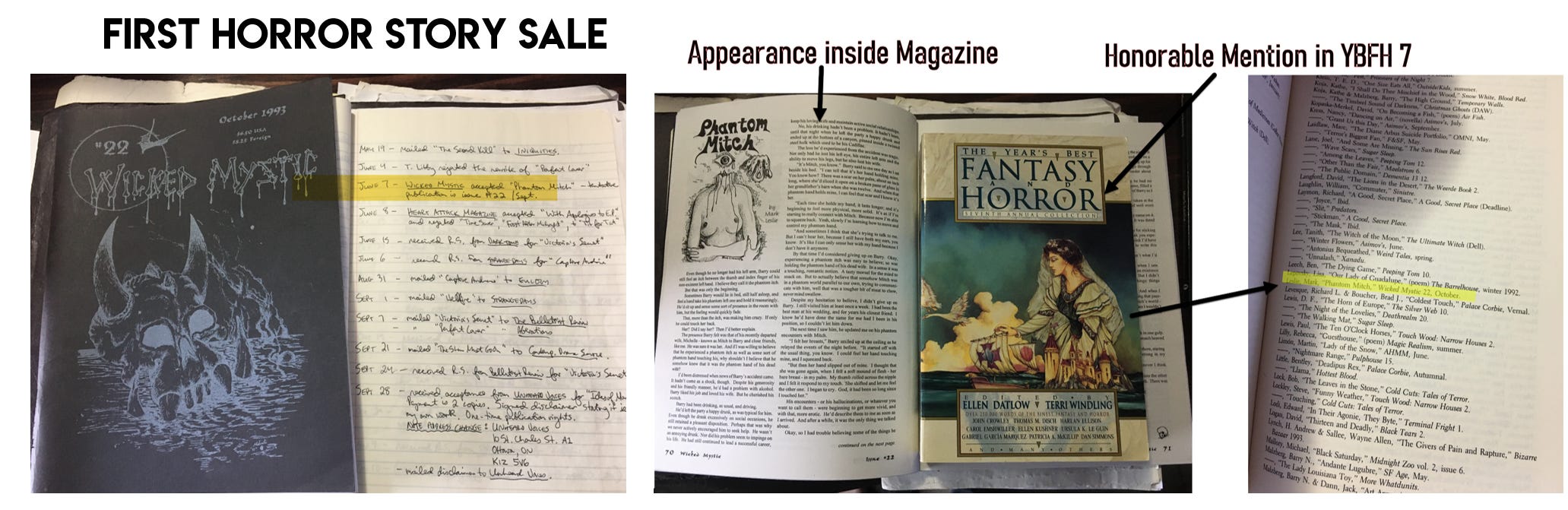
One of my earliest horror stories, “Phantom Mitch,” earned an honorable mention in The Year’s Best Fantasy and Horror back in the early nineties. It’s a tragic little love horror story about a man who loses his arm and his wife in the same drunken accident and becomes convinced that the phantom itch in the hand he no longer has is really her hand, reaching back for his, the connection growing more solid every time she holds on.
I can still summon the precise electric feeling of finding my name on that honorable-mention list, a few alphabetical inches away from Richard Laymon, one of the horror writers I had idolized—the sense that someone out there, someone with no obligation to be kind to me, had decided the thing I made was worth noticing. I have been chasing that feeling, in one form or another, ever since.
What I did not understand then was how easily the pursuit of it could curdle into something else. That Mark Leslie Lefebvre guy—the one who showed up to pay the bills while Mark Leslie could do his writerly thing—became a workaholic. Sixty-hour weeks, eighty-hour weeks. It cost me. It was a significant part of why my first marriage ended, and—the irony is not lost on me—it throttled the very creative output I kept telling myself I was working so hard to protect. You cannot write your way to a meaningful life if you never stop working long enough to actually live one.
So I would love to tell you that, thirty-some years and as many books later, the insecurity has finally gone quiet. It hasn’t. No matter how the surface looks, some stubborn interior voice still suspects I am a poser—a teenager in a grown man’s jacket, playing at being a writer, waiting for someone to tap me on the shoulder to check on my I.D. and then politely ask me to leave the exclusive club.
I suspect that a great many of you reading this know exactly the voice I mean. I have come to understand it never fully goes away. You just get better at driving and trying your best to concentrate on the highway ahead and navigating that next turn with it riding shotgun and constantly criticizing your driving.
But I don’t want this to be a pity party. Because I’ve had some pretty amazing moments along the way. Every so often, the universe hands you a small and entirely undeserved grace.
Last week I arrived early for an event at the Burlington Public Library. I had time to wander the stacks the way I have wandered bookstores and libraries my entire life. And there, scattered across different sections, on different shelves, I found eight of my own books. Sitting there. Doing the quiet and patient work that books do, which is waiting for the right reader to come along.
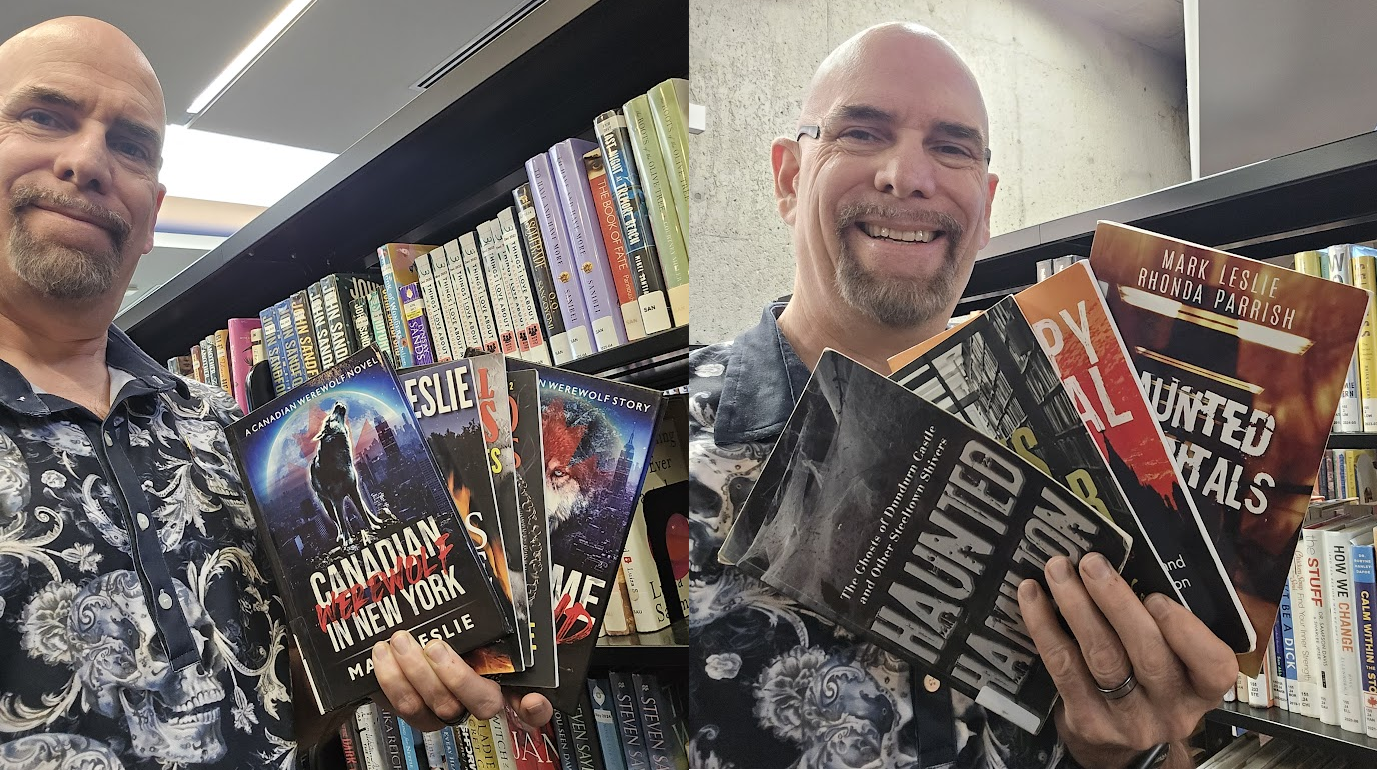
But they did another job that day. They made me feel like I was a real writer.
I do not have adequate words for what it feels like when you find one of your books in the wilds of a library or bookstore.
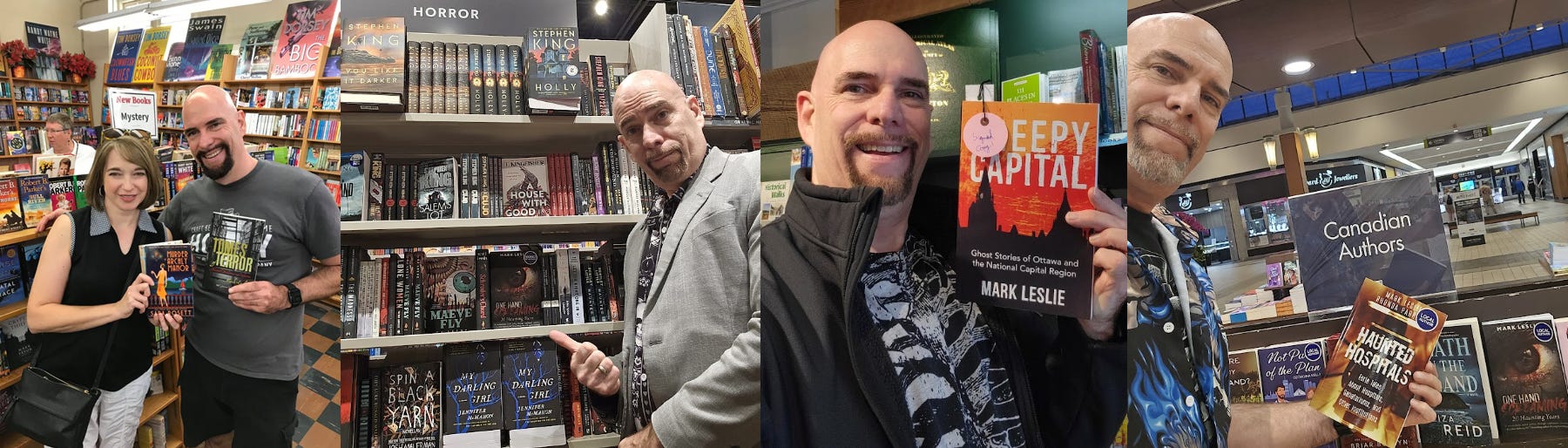
It is not the same as a sales report or a royalty deposit. It is older and stranger and more durable than that. It is the feeling I was actually chasing all along, back before I knew what to call it—the simple, staggering fact that something I made is out there in the world, on a shelf, available to a stranger, asking nothing further of me.
The platforms I work on every day are temporary vessels; the story is the permanent thing. A library or bookstore shelf feels like something close to that permanence made visible.
Which brings me back to the highway, and to Pittsburgh, and to the conference that had been waiting at the far end of the drive.
I attended StokerCon primarily as a horror author. I attended the mass author signing, but I also sat on a panel about bookstores at StokerCon—wearing my Mark Leslie author hat, but drawing upon the bookstore managing experience of Mark Leslie Lefebvre which felt good. I attended the Bram Stoker Awards and cheered on and celebrated both those who took home the award and all of the nominees.
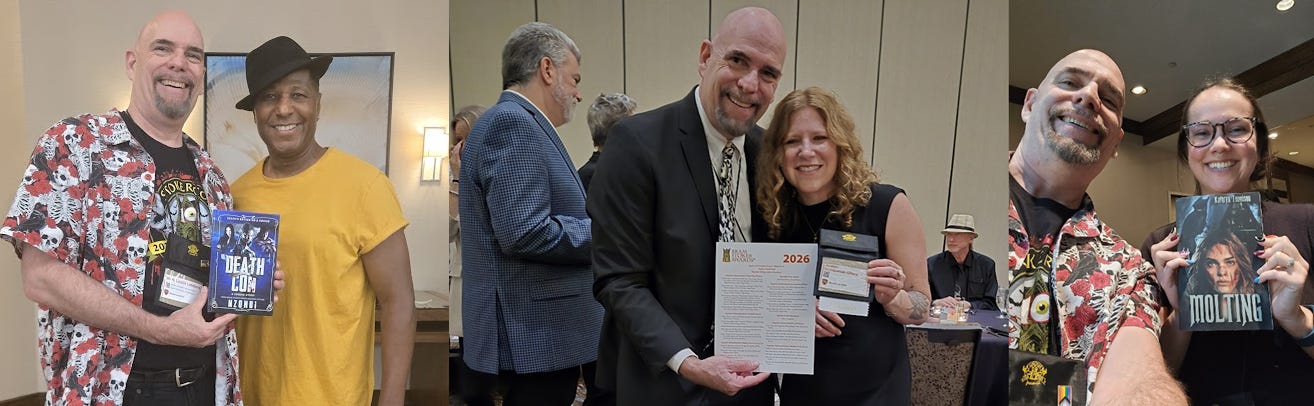
Mostly I got to stand in rooms full of the horror writers, many of whom I have admired since I was a teenager hiding under the covers with a flashlight and a paperback—and I get to call a good number of them friends. Some of them, the ones whose names I once found myself listed beside in alphabetical accidents of fate, I still have to remind myself are real and not figures from the back of a beloved book.
When I add it all up—and I will, somewhere long after yesterday’s drive home, because that is apparently who I am—the ledger never quite balances the way my anxieties insist it should.
But that is because I keep trying to measure it in the wrong currency. Whatever the trip costs, I get to spend my one life making up stories, helping other writers find their readers, and hanging around the people who love this strange craft as much as I do. That is not a hobby that got out of hand. That is the luckiest possible way to be unsure of yourself.
So if you are out there somewhere, doing the math in your head, hearing a fair question from a loved one as an accusation, half-convinced you are a poser who simply has not been found out yet—I cannot promise you the voice ever goes quiet.
But I can tell you what I intend to do about mine.
I am going to keep driving and flying to conferences as Mark Leslie along with that Mark Leslie Lefebvre guy who often dominates. But I’m going to keep driving and flying, and walking and running, and crawling and leaping with that Mark Leslie writer persona fully and firmly in place. I’m going to keep working at my craft. Keep sending out submissions. I’m going to keep learning the business of writing and sharing that knowledge with fellow authors. I’m going to keep showing up at conferences as both Mark Leslie Lefebvre and Mark Leslie. But I’m going to see about letting that more horror-themed guy start to stand taller, prouder, and to embrace all that he has done (and all that he has also sacrificed of himself) to further his writing life.
Because despite my second-guessing about the expense of both time and money at this weekend at StokerCon, I realized something.
I might have relegated Mark Leslie to the back seat numerous times over the years. But he never stopped paying attention to the road, attending to the navigation, learning from looking over that other guy’s shoulder.
While Mark Leslie Lefebvre was learning, and growing, and paying the bills, Mark Leslie was doing the work, in his quiet way, in the background, in the backseat, and in the shadows. All the while he was quietly waiting for those “full moon” nights so he could release his natural and darker nature into the world.
Sigh, no wonder I so enjoy writing about the dual life of Michael Andrews, the Canadian Werewolf who lives his “respected life” as a successful novelist, but that other, darker part of himself only roams free in the shadows and at night.
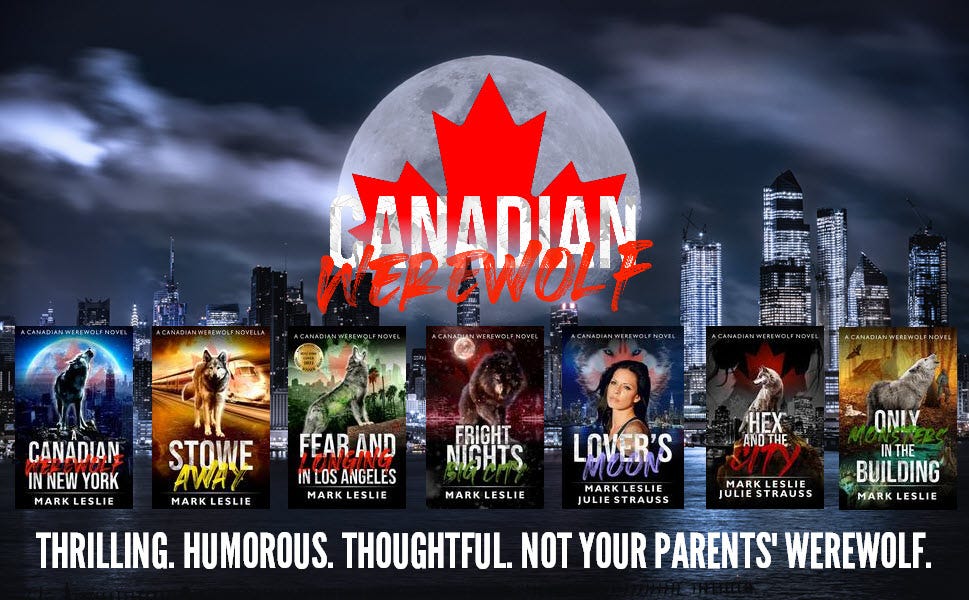
And sometimes, when the time is right, that “full moon” allowing Mark Leslie to appear can come at the most unexpected of times. Like when, on a sunny and bright afternoon you can clearly seen the lunar orb proudly beaming in the blue sky.
Because it happened during a somewhat life-altering moment this past weekend. I can’t yet share the details—at least not until the paperwork has been signed and the announcements are made.
But I was reminded that Mark Leslie isn’t so much in the shadows as I’ve led myself to believe. And that the quiet work he has been doing over the years has been cumulate.
And sometimes, when I least expect it, he dominates over Mark Leslie Lefebvre.
When someone I’d never met in person and knew only through a brief and limited online connection we’d had came up to me in the hallway asked if I was Mark Leslie, then said they wanted to ask me a few questions if I had the time, I immediately slipped into Mark Leslie Lefebvre the book industry guy, assuming they likely either had some questions about Draft2Digital, or perhaps wanted to learn more about the self-publishing/indie publishing/digital publishing realm.
So I offered a huge grin with that industry hat firmly in place, and prepared to openly and honestly share whatever it was I could help them with. My past experience as a bookseller, my insights into self-publishing, or publishing wide. My insider knowledge of the behind-the-scenes at Draft2Digital.
It turns out they weren’t there asking for help. And they weren’t interested in the Mark Leslie Lefebvre persona. It was all about Mark Leslie, the horror author. They wanted to talk to Mark Leslie about a writing-related opportunity. Something that, for me, is a pretty big deal.
Even before they finished talking and explaining the details of why they’d been looking for me, I felt my eyes well up. It was partially shock, partially unabashed joy, enthusiasm, excitement, and a tremendous amount of pride to be recognized for a lifetime of working at the craft of writing, and in particular writing horror, even though, at many times, it felt like Mark Leslie had been left behind, forgotten in the darkness where he skulks about.
I realized, as I fought back the tears threatening both my eyes and my voice, and we shook hands over a deal with the knowledge that the paperwork is still forthcoming, that I’d made the right decision to invest in StokerCon, and to invest in Mark Leslie. Like I’d wanted to do since I was about thirteen or so.
And that I was home, among my people.
A horror writer. An honest-to-God horror writer. Someone who’d toiled behind a typewriter since he was a young teen to write dark and moody stories and wanting to make people feel. Someone who’d felt that first blow of rejection on a submission at the age of fifteen, and thousands of rejections beyond that over the years.
Yes, I’ve had plenty of amazing high points as a writer over the years . . .
. . . including my first published horror story in 1993 making it as an honorable mention in The Year’s Best Fantasy and Horror, my first professional short story sale in 2001, my first self-published horror story collection book launch in 2004, my first traditionally published non-fiction true ghost story book in 2012 (with that same book being selected for a “One Book, One Community” program in 2025), seeing more than one of my books on a huge skid at Costco, and so much more . . .
. . . but for the first time I could feel that consistently dominant imposter syndrome begin to crack. No, I know it won’t ever truly go away—but for the first time it was overshadowed by two really amazing feelings.
That sense of hard work, accomplishment, and a life spent writing, and loving writing, never giving up on Mark Leslie despite the roller-coaster ride I’d been on, landing me an opportunity because of trying something I’d truly thought, at the time, was the longest of all possible long shots.
And that I’d found—or at least re-discovered—my home, my people, my community, my horror self.
Before I left Pittsburgh for the long drive home, I had already purchased my membership to next year’s StokerCon in 2027.
I’m back, baby. Mark Leslie is back. Back in black (yeah, I know, my ADHD brain couldn’t resist pausing for an ear-worm while trying to write an emotionally powerful ending). Back in skull-print t-shirts, polos, and button-downs.
Back to stand in his rightful place alongside Mark Leslie Lefebvre. And sometimes even in front of him.
Argh... I wish I'd gone to meet you in person! This has me bawling. You nailed the whole dual identity. Are we artists masquerading as professionals or professionals masquerading as artists?
That rush of seeing your books in the wild is one I will always cherish. You're correct in saying that it offers validation and confirmation that we're *really* real writers.
Watching someone check out one of my books from the library was such a thrill.