
Stretching Before the Writing Run
How Writing Parody Song Lyrics Became My Secret Creative Weapon

I want to share a warm-up ritual of mine that might sound strange.
Actually, let me rephrase that. It will sound strange. Or more likely, it is strange. Okay, I’m strange. But I’m okay with that.
But, in all seriousness, this little ritual has been one of the most reliable creative tools in my toolkit for decades, and I think there’s something in it for every writer—even if your version looks nothing like mine.
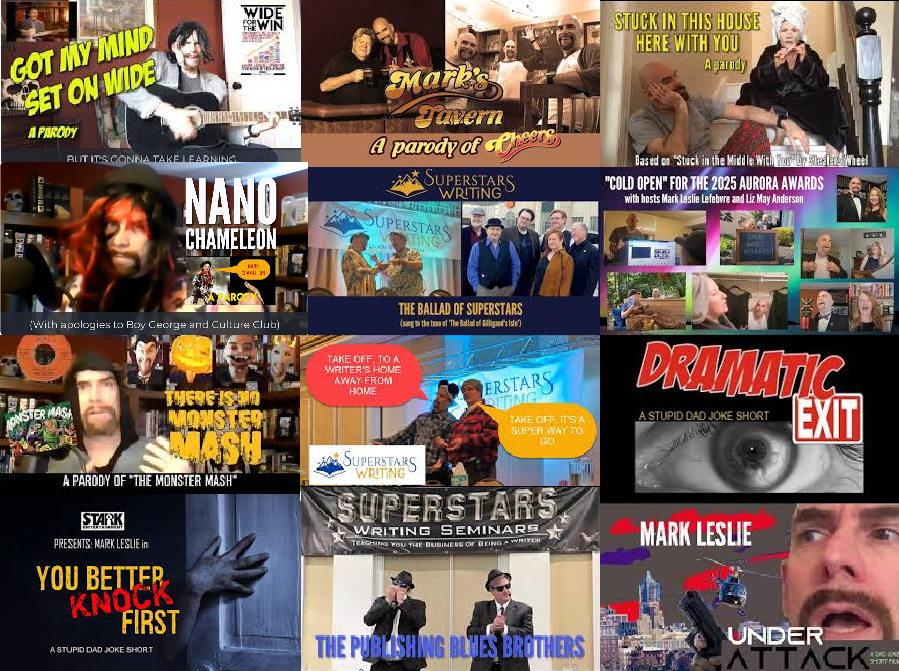
I write parody song lyrics.
That’s it.
When I was younger, before I likely even properly knew the term “parody” I used to call it “Weird Al-ing a song.” I remember back in Grade 7 or 8 telling a friend that I created a “Weird Al style” adaptation of some popular song. I’m pretty sure it wasn’t until the mid 90’s that I realized the term was “writing parody lyrics.”
I’ve found it to be a helpful warm-up exercise I sometimes do before a writing session, particularly at times when the gears feel rusty and the words aren’t flowing. That’s when I’ll take a song I know well and rewrite the lyrics to fit whatever absurd premise occurs to me.
Sometimes it’s topical. Sometimes it’s personal. Sometimes it’s just ridiculous.
There’s something about the constraint of it—forcing my creative mind to match a syllabic beat, to find words that rhyme in the right places, to work within a rigid structure while producing something entirely new—that lubricates the creative gears in a way nothing else does for me.
It’s like stretching before a run. Those creative writing muscles need to warm up before they’ll perform.
Most of the time, these parodies go into a folder, or just get tossed out into the recycle bin and are never seen again. They’re doodles. Scribbles. Creative throat-clearing. They might just be the lyrical equivalent of a sketch artist filling the margins of a notebook while waiting for the main composition to reveal itself.
But every once in a while, something unexpected happens.
And when it does, the results have taught me more about creativity, collaboration, and the nature of storytelling than most of the “proper” writing I’ve done.
I’ve found incredible value in the way the constraints of this format can actually liberate me as a writer.
Before I get into any specific stories, I want to talk about why this works—at least for me.
Writing parody lyrics is an act of simultaneous destruction and creation. You’re taking an existing structure—melody, rhythm, rhyme scheme, syllabic pattern—and you’re filling it with entirely new content.
You can’t just swap out a word here and there. The new lyrics have to sing (yes, pun fully intended). They have to flow naturally against the beat. They have to land on the stressed syllables the way the original did, or the whole thing falls apart.
That means your brain has to work in multiple dimensions at once. You’re thinking about meaning and sound and rhythm and humor and wordplay, all simultaneously. You’re solving a puzzle while telling a joke while writing a poem while keeping time.
And here’s the thing: all of those muscles are the same ones you use when you’re writing fiction, or non-fiction, or anything else. Rhythm matters in prose. Sound matters. The interplay between constraint and freedom matters. When you write within a tight structure, you discover combinations of words and ideas you’d never have found in the open field of a blank page.
Parody lyrics are my way of tricking my brain into doing creative heavy lifting before it realizes that’s what’s happening.
And boy oh boy, has this ever helped me get unstuck when I’m stuck.
Such as the time early on during the 2020 pandemic, when I my wife and I were literally stuck in the house in isolation. Or, as I parodied:
Stuck in this House Here With You
In the early days of the COVID-19 pandemic, I was anxious. I was creatively blocked. I was frustratingly stuck. Pre-planned business and personal trips had been cancelled. Life was changing dramatically. I had a slew of writing projects lined up with expectations of working on them that year, but nothing was flowing. The words had dried up in a way they hadn’t in years, and the underlying anxiety of the world situation—such as not being able to see my teenage kid, who was in an isolation bubble at his mother’s house—made it worse.
So I did what I always do when the gears seize: I wrote parody lyrics.
One morning I sat down and rewrote the Stealers Wheel classic “Stuck in the Middle with You.” The new version was about being stuck at home during lockdown, surrounded by shedding pets, boredom, and creeping irritation with one’s partner.
A few months earlier my partner Liz and I had seen the stage show Bat Out of Hell: The Musical. In it, the Meatloaf classic song “Two Out of Three Ain’t Bad” was performed as a duet. That blew my mind, because while I’d always loved that 1977 classic, Meatloaf had performed it as a solo performer. But in the stage show that song was performed as a duet.
I used that inspiration to re-write the lyrics for the Stealers Wheel classic into a duet between two people whose love for each other was being tested by the novel experience of spending every waking hour in the same house.
Normally, lyrics like that would have gone into the folder and been forgotten. But something about these felt different. They were good. They were funny. And they captured a feeling that millions of people were experiencing at that exact moment.
I read them to my partner, Liz.
She smiled and laughed appropriately, most likely just humoring me while wondering how much longer she’d be stuck alone with me. Then I suggested that like in that musical we’d seen, the song could be turned into a duet, and we could perform it together.
Liz’s first response was looking at me like I had three heads. I guess, basically her reaction might have been the lyrical equivalent of that original Meat Loaf song: there ain’t no way she was ever going to sing this.
But a couple of days later, she came back with ideas. Liz had long been a creator of fun video shorts—though she typically preferred to stay behind the camera. This time, she agreed to step in front of it.
And that’s how we spent Easter weekend 2020.
One day was spent recording and mixing the song itself. That alone was a lot of fun as we realized there were plenty of notes I just couldn’t hit; or at least couldn’t maintain consistently. Let’s just say that I sing with a lot more passion than talent.
The next day was spent running around the house, changing costumes and settings, and shooting the video. It was the perfect distraction from what would normally have been (as it had in previous years) of having all of our kids together in the house for a family weekend—the type of gathering that the pandemic had made impossible.
I published the video to my YouTube channel.
It didn’t go viral. But it took off in its own small way. Friends and colleagues found it and loved it. So did thousands of others. A CTV television affiliate in Ottawa picked it up and featured it in a segment called “The Lighter Side.” Shortly after, a CTV affiliate in Sudbury covered it too.
No, it didn’t make us famous or rich.
But it did something better.
It broke the dam. It reminded me that though I’d defined myself as a writer for decades, I’m ultimately a storyteller—in multiple formats, in multiple mediums. And once that realization settled in, the rest of my writing began to flow again. Not just the fiction I’d been trying to force, but an all-inclusive creative output that I hadn’t even known was waiting behind the block.
That pandemic parody wasn’t an endpoint. It was an opening.
Once I’d tasted the creative joy of bringing a set of parody lyrics to life on screen, I kept going. Some of the videos that followed were adaptations of stupid dad jokes turned into parodies of genre films. Others were further song parodies, each one scratching a different creative itch.
There was “Mark’s Tavern,” a parody of the Cheers theme song. There was “There Is No Mash,” a riff on “The Monster Mash.” There was “Nano Chameleon,” a play on Culture Club’s “Karma Chameleon.” And one that I wrote specifically with the concept of my book Wide for the Win in mind: “Got My Mind Set on Wide,” a parody of the George Harrison classic “Got My Mind Set on You.”
None of these pursuits have made significant money. Okay, most of them haven’t made me money. Not yet, at least. (Okay, perhaps some of the stupid dad jokes ones have, since I did release a book that was a collection of dad jokes in the fall of 2025 (I Think it’s a Sign that the Pun Also Rises). And my book One Hand Screaming: 20 Haunting Years which has earned me decent income does contain a few parody poems. My poem “Frost After Midnight” was a dark and twisted parody of the Coleridge poem “Frost At Midnight.” My poem “With Apologies to E.P.” is essentially a dark humor parody of the Elvis song “Are You Lonesome Tonight” and my poem “Wailin’ Jenny” is a parody of the Waylon Jennings/Willie Nelson song “Mammas Don’t Let Your Babies Grow Up to Be Cowboys”).
But the point of these parodies and silly exercises aren’t about making money.
Because they satisfy something that goes deeper than the pocketbook. I write to share stories, to connect with people, and to make them feel something.
And often, that feeling, simply, can be laughter.
In addition to parody songs and videos, I’ve also adapted stupid dad jokes into short “films” that are mostly a long setup with a dumb punch-line.
Or even a parody song addressing the fact that most people—even long-time friends—still can’t pronounce “Lefebvre” (a parody of the Little Willie John classic that Peggy Lee made famous: “Fever” which I’ve adapted into “You Call Me Fever.”)
These experiments with video and audio fulfill that part of who I am in the same way I’m fulfilled when sharing information and inspiration with fellow writers.
It’s just another element of the storytelling that defines who and what I’ve been my entire life.
And here’s what I find interesting: the creative momentum from these “side projects” didn’t stay contained. It bled back into my writing. Into my podcasting. Into the way I approach presentations and workshops. Starting to create this kind of content removed blocks I had previously placed on myself, and everything started to flow more freely.
One of the joys of writing parody lyrics is that they can become a shared experience.
At Superstars Writing Seminars in Colorado Springs—a conference that has been profoundly important to my development as both a writer and a human being—I’ve had the pleasure of performing parody songs with my friend James A. Owen. If you know James, you know he’s one of the most eloquent, passionate, and magnetic speakers in the writing community. What you might not know is that the man is also a willing co-conspirator when it comes to musical shenanigans.
Over the past several years we’ve opened up the conference’s annual charity auction by doing a combination skit that features brothers and a parody song. We’ve done The Blues Brothers, Bob & Doug Mackenzie, Thor & Loki, and Two Wild & Crazy Guys.
There’s something about performing a parody in a room full of writers that amplifies the joy of it tenfold. These are people who understand wordplay at a molecular level. They catch the clever substitutions. They groan at the forced rhymes. They laugh at the absurdity of two grown men belting out rewritten lyrics about the publishing industry set to tunes everybody knows. (Heck, the first year we even wrote a parody version of one of my favorite Weird Al songs—one of his original rather than parody songs: “One More Minute” which we sung to the crowd as The Publishing Blues Brothers.)
And in those moments, something happens that’s hard to manufacture any other way: genuine human connection through shared creative play.
That’s not a small thing. In an industry where so much of the work is solitary—where the act of writing is, by its very nature, a conversation between you and the page—those moments of communal creative joy are medicine.
But The Ritual Isn’t the Point
Here’s where I want to be careful, because I’m not writing this to convince you to start scribbling parody lyrics. That’s my thing. It works for me because of who I am, what I respond to, and the particular way my creative brain is wired.
What I am telling you is this: find your equivalent.
Find the ritual that signals to your brain that it’s time to create.
For some writers, it’s reading a page of their favorite novel. For some, it’s freewriting in a journal for ten minutes. For some, it’s making a specific kind of coffee in a specific mug and sitting in a specific chair. I know writers who do crossword puzzles. Writers who sketch. Writers who take a walk around the same block in the same direction every single time before they sit down to work.
The ritual itself is arbitrary. Its purpose is not.
What these warm-up rituals do is create a bridge between the non-writing part of your day and the writing part. They’re a threshold. A doorway. A signal that tells the creative mind, “We’re shifting gears now. The analytical, logistical, errand-running, email-answering part of the day is pausing. It’s time to make something.”
Without that bridge, many of us sit down at the keyboard and spend the first thirty minutes (or sixty, or ninety) still mentally sorting through the noise of everything else. The warm-up shortens that transition. It gets the creative engine turning over so that by the time you’re facing your actual project, the words are already in motion.
Make sure that you give yourself permission to play.
I think there’s another reason this practice has served me so well, and it’s one I don’t see discussed enough in writing circles: it gives me permission to be bad.
Parody lyrics are, by definition, not serious. Nobody is going to judge the literary merit of my rewritten version of “Karma Chameleon.” Particularly because I’m singing about the genitals of a lizard. And that’s just it. There are no stakes. There is no audience (unless I decide there is). The only requirement is that I show up and play.
And play, it turns out, is not the opposite of serious work. It’s the foundation of it.
When I give myself permission to write something silly, something disposable, something purely for the fun of it, I’m dismantling the perfectionism that so often sits between me and the page.
I’m reminding myself that first drafts don’t have to be good. That creativity is a muscle, not a performance. That the act of making something—anything—is its own reward.
By the time I pivot from the parody to the project, the internal critic has been quieted. Not silenced—that voice never fully shuts up—but settled. Lulled into a kind of amused tolerance by the silliness that preceded the serious work.
Okay, now it’s YOUR turn!
If you’ve been struggling with your writing lately—if the words feel stuck, if the blank page feels more like a wall than a canvas—I’d encourage you to stop trying to power through it. Instead, try warming up.
Find the creative equivalent of stretching before a run. It doesn’t have to be clever. It doesn’t have to be shareable. It doesn’t have to be good. It just has to get the gears turning.
Write a limerick about your cat. Rewrite a nursery rhyme about your work-in-progress. Sketch your protagonist’s living room. Write a fake movie review for the novel you haven’t finished yet. Compose an imaginary interview with your villain.
Do whatever gets the creative juices flowing, and don’t apologize for the mess it makes.
Because sometimes the mess is exactly where the magic hides.
And if you happen to write a killer parody of a classic rock song in the process—well, send it my way. I promise I’ll laugh. With you. Not at you.
Mark Leslie Lefebvre is the author of more than forty books, the host of the Stark Reflections on Writing and Publishing podcast, and the Director of Business Development at Draft2Digital. He writes horror, true ghost stories, urban fantasy, and thrillers—and occasionally rewrites other people’s hit songs very badly. You can find him and his various creative misadventures at markleslie.ca.
Love that song, wish I'd known it back during the pandemic; the wife and I could have sung it together. Similar situation :-)
Love the videos! Especially the Stuck in This House with You. I love making up song lyrics and singing them to my cats.