
Taking the Path That Gets You the Better Story
The deliberate lines you draw on the page of your writing life

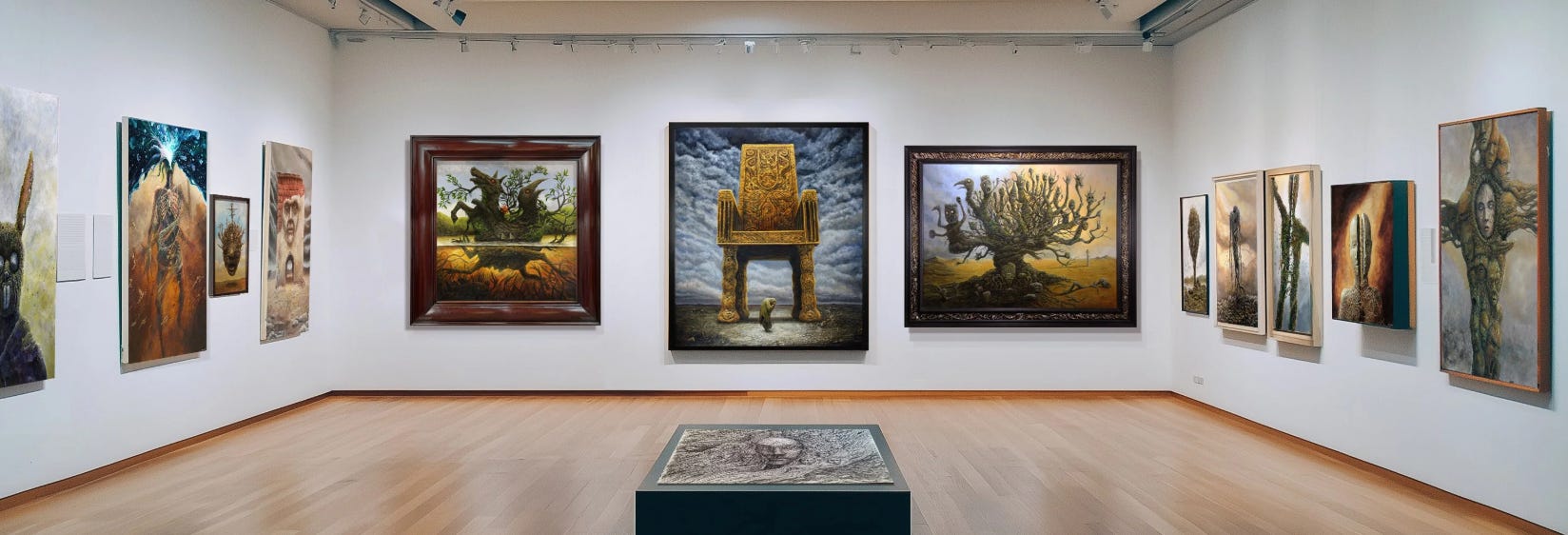
Last weekend I was in a conversation at TriCon in Halifax (The Trident Conference for Speculative Fiction) when fellow author Deanna Foster passed along something that her partner, Canadian artist Frank Forrestall, had said.
Always take the path that’ll get you the better story.
I’ve been reflecting on that one repeatedly ever since.
One of the things it made me think of was something my dear friend James A. Owen says in his talk and book, Drawing Out the Dragons. I’ve had the privilege of seeing James give that talk in person more than a dozen times over the years at Superstars Writing Seminars. I’ve also read the book and listened to the audiobook numerous times. I always gain such important reflections from it.
When beginning the talk, James says that drawing a dragon begins with a single line. And he begins by sketching that single line. Then he draws another, then another, as he tells his story and until, after a succession memoir anecdotes and carefully placed lines the creature appears.
The point isn’t James’s dragon. It’s yours. Every life, James reminds us, is shaped by a series of deliberate choices. Carefully considered choices. Goals, dreams, desires, plans, and, of course, execution of those plans.
You make the initial marks. What emerges on the page from there is entirely up to your own will and determination.
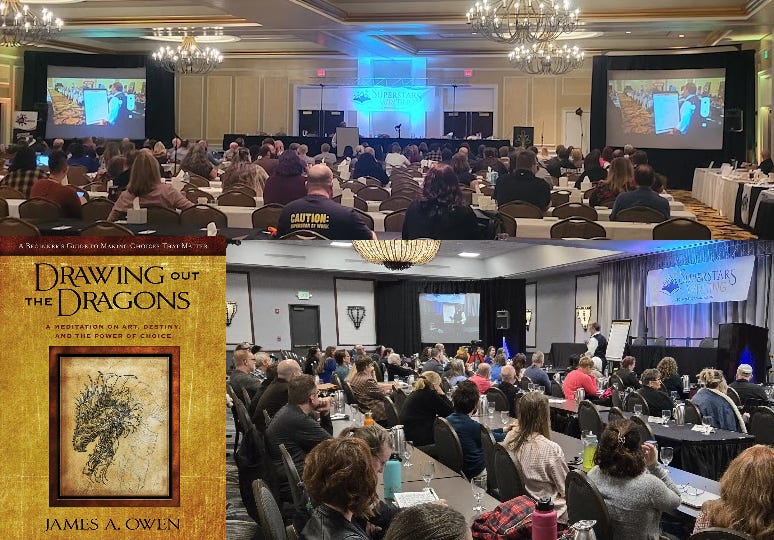
Two different artists said things in a different way, but ended up drawing out the same thing in my mind.
The choices you make in everything you do are the lines you draw. And the lines you draw become the story of your career.
We tend to think about choice when we’re writing—what genre to lean into, whether to kill the character we love, whether to set up a structured outline to follow or to boldly embrace that blank page and to follow the gut.
I’m also reminded of advice, when writing a story, to not always go for “the low-hanging fruit.” It’s a term I learned when attending WMG Anthology workshops over the years. It’s about a writer running with the very first idea that comes to mind when given a theme or story submission guideline. It’s about digging deeper, looking beyond that first spark, or at least exploring it in more depth.
So yes, there are choices we make in our writing. In how a story develops and how it goes. But there are also choices we make in our author careers. In things we decide to write, and the ways we decide to write them.
Those are real choices, and they matter. But the more I think about Frank’s expression and James’s talk and book, the more I’m convinced that the choices that shape an author’s life have very little to do with the page itself.
They have to do with who you decide to be on the way to the page.
What kinds of stories do you actually want to tell?
Not the ones related to the gaming that you keep hearing you need to engage in to appease the mysterious Amazon algorithm gods.
Not the ones the latest “write to market” hot take someone insists are the only path to a career.
Not the decision to pursue traditional publishing or to take the more DIY self-publishing approach.
Not the decision to be all in on Amazon exclusivity or to publish WIDE.
I’m talking about the ones that are going to lead to the more interesting stories.
They might be as simple as the things that wake you up at three in the morning and won’t leave you alone. Or the ones where you are almost guaranteed a specific outcome if you decide to do one thing, but something calls at you to take that other path, the one with the uncertain, but potentially more interesting result.
That’s a choice. A deliberate one. Choosing the harder, less obvious story because you know—the way Frank seems to have known on whatever path he was facing when he said it—that the better story is the one waiting down that road.
In addition to those choices along the way it’s important to ask yourself an important question: What kind of author do you want to be?
And I don’t mean brand. Brand is just the surface—the sport coat, the skeleton sitting at the table, the logo and color palette on your website. I mean the deeper thing. How do you treat the bookseller who has thirty seconds for you between customers? How do you respond to the author who emails asking the same question you’ve answered a hundred times before? How do you behave on a panel when a fellow author says something you disagree with—and, more importantly, how do you behave in the con suite afterward, when they aren’t in the room?
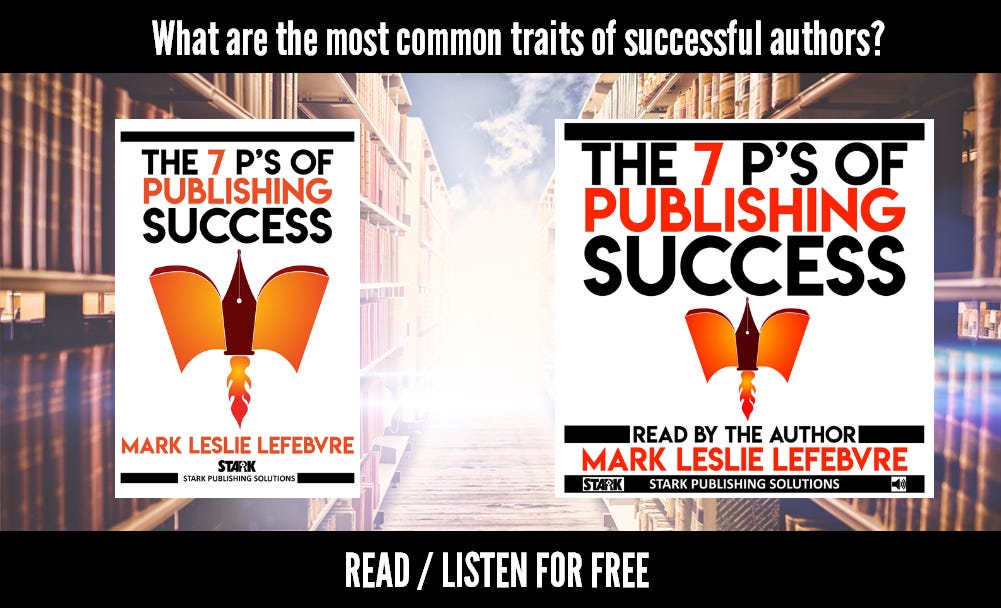
When I wrote The 7 P’s of Publishing Success, I kept circling back to one idea inside the Professionalism chapter that I want to repeat here, because I don’t think it can be said often enough: assume that everyone is watching all the time, and behave accordingly. Not because behaving well is a marketing strategy—although it technically is—but because the way you treat people, the small choices you make in every interaction, is the dragon you’re drawing.
People remember. Booksellers remember. Librarians remember. Other authors remember. Readers remember. And the version of you who walks down the hallway at a con—distracted, dismissive, half-scrolling your phone while someone tries to talk to you about your book—that’s a choice too. It’s another line placed onto that page.
This is where being present matters much more than I think we give it credit for. Showing up is not the same as being there. You can attend every conference, sit on every panel, post on every platform, and still be absent from your own life and your own community.
Going to and getting to TriCon in Halifax, Nova Scotia from Waterloo, Ontario was part of me making a deliberate choice. Okay, several deliberate choices. But let me break it down and simply share a couple of them.
The first was actually attending this new conference when I first found out about it when I was at CanCon in the fall of 2025. It was taking a chance to spend the time and money to go to a new conference in its first year. Sure, a few writer friends I knew and respected had been planning on going. That helped. But saying yes to investing in an event like that often means saying no to other events, other opportunities happening at the same time.
I chose to go. Why? Several reasons. As I mentioned, several people I knew had made the decision to go. At the very least I’d get a chance to spend more time with them. I don’t see fellow Canadian authors and industry people as much as I like, so that’s a good investment that feeds my soul.
I also hadn’t been to Halifax since 2017 when I attended Word on the Street Halifax thanks to a grant from one of my publishers. It’s a phenomenal city I love visiting. It has inspired numerous stories I’ve written over the years. And on my recent visit to Ireland I was reminded of a few spots from the lovely province of Nova Scotia. So TriCon was the perfect excuse to return.
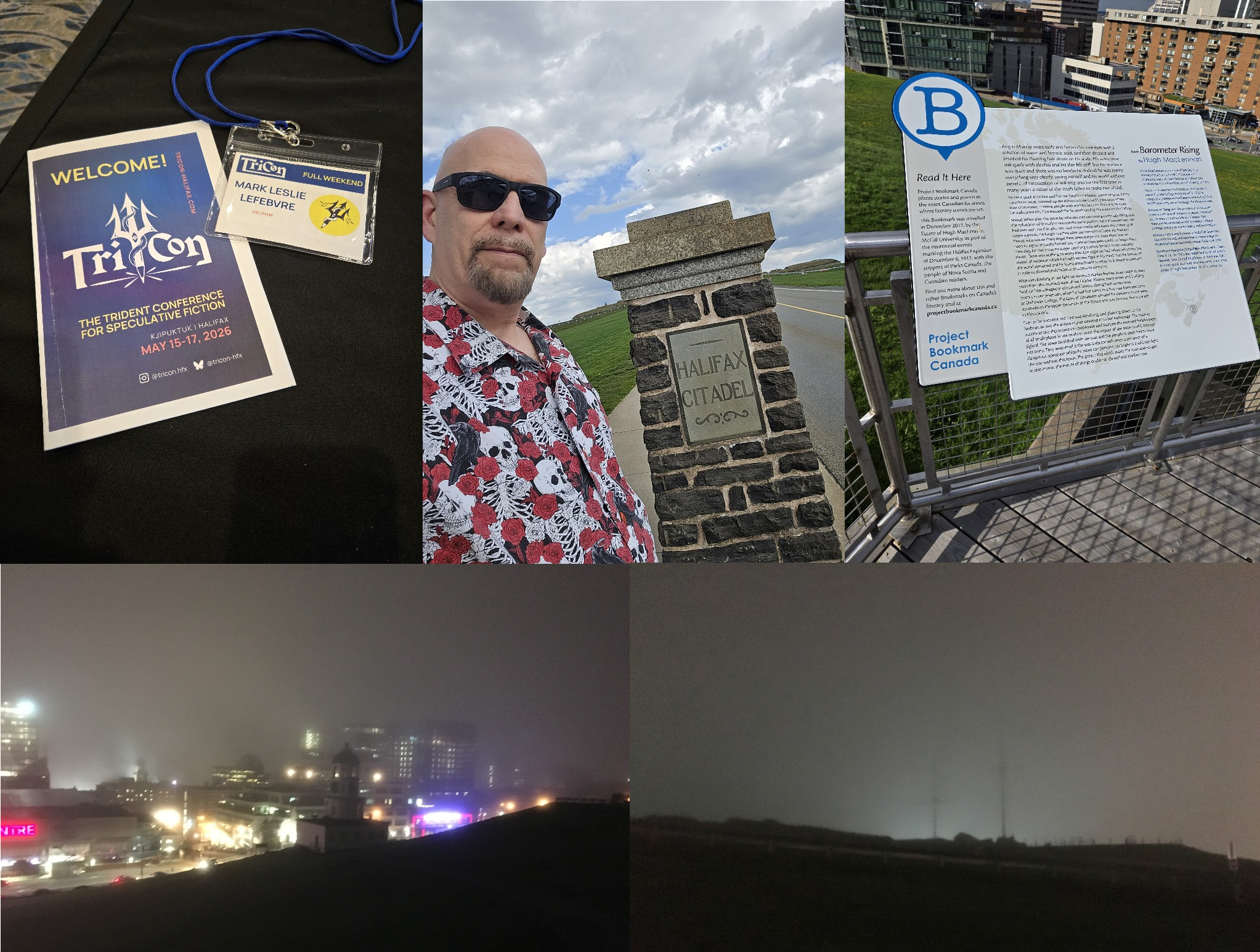
The second choice was in how to get there. I could have flown. It’s roughly 1,900 km (1180 miles). It’s a 2 to 2.5 hour flight from Toronto. Or a close to 18-hour drive from Waterloo and taking me across four provinces. I drove, and Steve, a BFF living in Ottawa, joined me for most of that journey. We took several days to get there and back, enjoying numerous stops along the way.
Steve and I have known one another for most of our lives and have been good friends since about the age of fifteen. We’re both big Rush nerds. So it would come to no surprise to anyone who knows me that the words and lyrics of Rush drummer and lyricist Neil Peart often have an impact on decisions I make.
Neil wrote in his memoirs about the magnificence of experiencing the countryside on bicycle and motorbike, which he often did instead of taking the tour bus between cities when touring with the “guys from work” as he called his fellow band mates.
And in the song Time Stand Still” he talks about old friends growing older and the value of passing an evening with a drink and a friend. So we made memories, with a lot of meaningful conversation while driving and enjoying numerous spots to share a pint and our ongoing musings about life, the universe, and, you know. Sometimes it was just the two of us. Other times it was with other friends. But always, it was a rich experience.
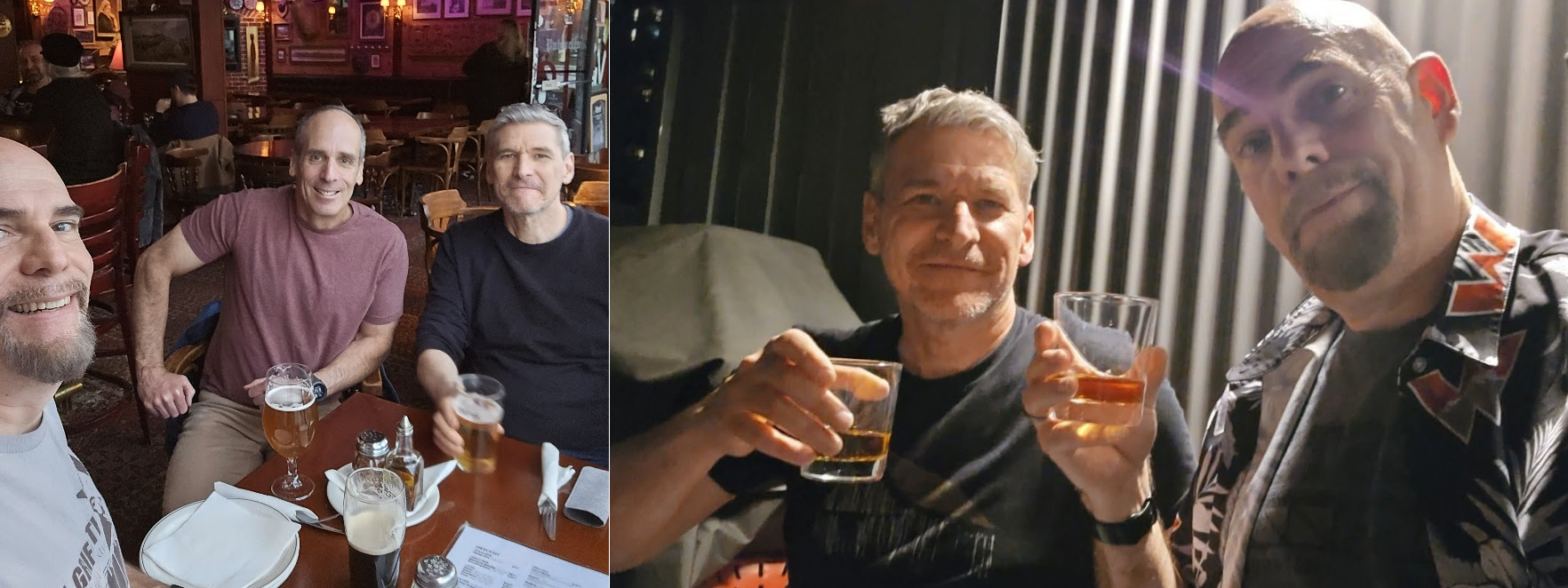
This trip also led to a really cool acquisition of something I’ve longed for since I was a teenager and relates directly to my writing life. And it happened because of a chat with a stranger at a brewery in Saint John, New Brunswick on that road along the way. It’s perhaps a story for another day, but for the very curious I reflected upon it in Episode 475 of my podcast where I interviewed Jeff Elkins on the idea of writing emotion and making the reader feel.
Ultimately, the 10 day road trip instead of the 4 day flight brought unique riches of seeing places and meeting people I otherwise would not have enjoyed. They’ve helped me drawn far more richness into my life.
Steve and I spent a lot of time at various pubs and bars on our trip. Conversing, as we do. One of the things Steve and I noticed, and talked about—and it’s also something that my partner Liz and I have paid attention to when either traveling or when we’re out together for dinner and a drink—is how many people are out together and yet neither of them are in the moment.
They are sitting across from one another and yet not actually attending to one another. Their heads are bent down as if trapped by the smart phone held in their hand like its some sort of oracle. They are physically present, but the rest of them seem like they’re rather be somewhere else.

Yes, I bring my smart phone almost everywhere with me. Yes, I use it to take photos (though not nearly as many photos as I should, nor as many selfies with cool people I get to meet and hang out with). Yes, I track the new beers I’ve enjoyed on the Untappd app. Yes, I track my calories consumed in a different app in my attempt to shave off that bulge around my middle.
But I do try really hard to BE in the moment when I’m out. I try to make that deliberate choice to be present. To attend to the people in front of me rather than the dopamine hit that awaits in the FOMO act of picking up that phone to see what I might be missing out on. And I find that often when I choose to embrace the physical space and the moment I’m in, I’m richer for it. I catch something I would have otherwise missed. It could be something that later comes back as an element in a story. It could even be something that results in one of these reflective articles.
But like a person distracted by the vibration of that phone on the table, I digress.
Let’s get back to the decision to go to TriCon. I did it because I wanted to spend more time with more Canadian authors and industry folks. To actually be with them. To sit in the audience during panels, to linger longer for those hallway conversations. To enjoy longer conversations over meals together. And to embrace this life as a writer that I’ve continued to choose over the years.
TriCon was a deliberate choice. And an investment in myself, and in my community. It wasn’t just a choice to invest money and time into being at a conference. It was to actually BE there in a meaningful way.
The choice to actually be present—to make eye contact, to listen to the question being asked rather than the one you’d prefer to answer, to remember the name of the person who drove two hours to come to your in person book signing, that fan who comments on so many of your social media posts, or the bookseller whose shelf-talker note you spotted recommending your book at a bookstore you went into last year—is one of the most consequential and least glamorous choices a professional writer ever makes.
It’s also one of the ones that eventually builds the better story.
My mom gave me some advice when I was a teenager and kept saying that I wanted to be a writer. She said I should get a good job if I wanted to write. Because writers don’t make much money. She was right. I know that now. Most writers don’t make much money. Through numerous sales data channels I know this as a fact. Heck, I know it as a fact from my own experience.
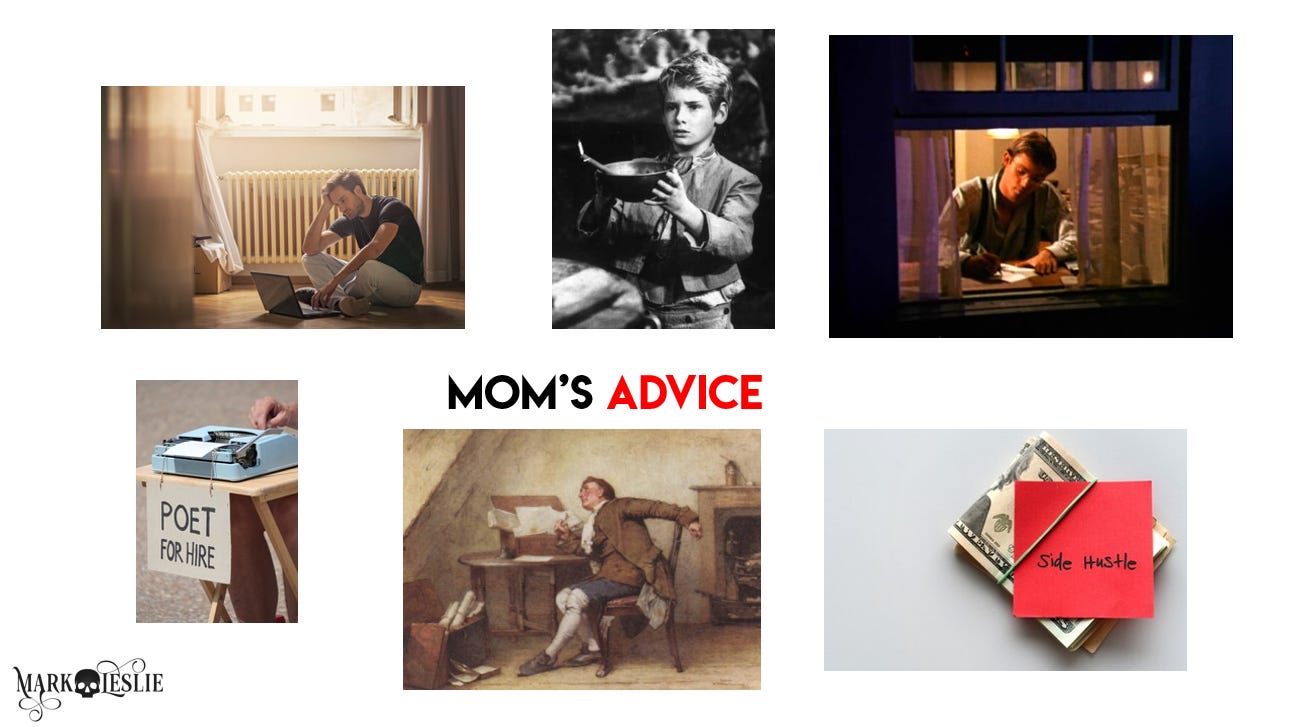
Though I started submitting my writing for publication in the mid 1980s I didn’t sell my first story until 1992. And though my first book was published in 2004, it wasn’t until 2017 and many more books and stories published that I finally started earning enough money as a writer (and a low to mid 5-figures is where I’m at most years) that I didn’t need to work full time.
I knew it would be hard, but I pursued it. I chose that. And while I knew I needed a job, I didn’t choose something that paid well. I decided upon something that I was passionate about that paid peanuts. I worked in retail as a bookseller, for minimum wage. I did this when so many other options I could take paid more. Even as a bookstore manager I worked below the poverty line for years. I did, eventually, work my way through and upwards within the book industry until I was earning respectable income.
Every step along the way I made decisions on which direction to take. Which position to reach for. Which path to choose. Which line to draw. I was determined that I wanted to write. So I kept writing, despite it not paying for so many years. And I kept choosing ways to be a bookseller and a bookstore manager, and eventually a book industry representative in ways that could exploit my passion and skills but always in a way that I could be true to who I was.
I decided to self publish a book in 2004 despite being told it was the best way for a writer to kill their career before it even began. But I did it anyway.
I decided to leave a job after 17 years to spend more time with my child and for writing.
I left another job I loved to go build something truly remarkable that continues to help other writers to this day.
And then I left full-time employment at a high-paying job with great benefits in order to pursue more time for writing.
I took numerous chances along the way. But the choices I made were always calculated. And they factored in the things I was most passionate about.
It wasn’t easy. And I’ve been lucky along the way—so lucky! But I kept making choices. I kept drawing those lines to create my own dragon. Even when I wasn’t sure if that pen was going to run out of ink.
James has another line from Drawing Out the Dragons that I regularly reflect on: “If you really want to do something, no one can stop you. But if you really don’t want to do something, no one can help you.”
He’s pointing at the same truth Frank Forrestall was pointing at. The path is yours. Nobody else is going to walk it for you, and nobody else gets to decide which one you take.
James talks about deliberate choices that we make. And that all those choices are cumulative. And that’s how we draw those dragons. That’s how we draw out who we are as authors, and as people.
So here’s the question I’ve been chewing on since TriCon, and I’ll offer it to you to consider. Of the choices in front of you right now—the project you’re considering, the relationship you’re building, the conversation you’re avoiding, the physical space that you’re about to walk into—which path gets you the better story? And which path gets you YOUR story?
So pick up that proverbial pen. But make sure it’s deliberate. And that you’re present for that choice. And then draw that line. Then the next one. Then the next.
Love this. Drawing out the Dragons is a life-changing talk.
There’s always a choice. Not choosing (just letting things happen) is a choice. Plus, there are really no wrong choices, just choices with different outcomes. Different dragons 🐉 , you might say.